Some of the biggest channels on the internet have never shown a face.
WatchMojo has 100 million subscribers. Kurzgesagt has 24 million. Lofi Girl has 13 million. None of them have a recognizable presenter. They built massive audiences on the strength of their content — not their camera presence.
Faceless videos remove the single biggest barrier to creating content: being on camera. No filming setup, no lighting, no performance anxiety, no time spent on makeup or sound. Just content — and an audience that wants to watch it.
With AI tools in 2026, making professional-quality faceless videos no longer requires a production team or advanced editing skills. You describe what you want, the AI builds it, and you publish. This guide covers everything: what faceless videos are, which formats work on each platform, and a complete step-by-step process for creating them with AI.
What Is a Faceless Video?
A faceless video is any video where the creator doesn't appear on camera. Instead of filming themselves, creators use a combination of:
AI-generated visuals or stock footage matched to a narration
AI voiceover or recorded audio without video
On-screen text, captions, and animated graphics
Background footage (gameplay, nature scenes, ambient environments)
Screen recordings or product demonstrations
The creator stays completely off-screen. The content carries the video — not a personal brand or on-camera personality.
Faceless videos are used across every content category: educational explainers, documentary storytelling, storytime and Reddit narrations, lofi study streams, product reviews, finance commentary, true crime, and more. Virtually any topic that can be explained, narrated, or demonstrated can be produced as a faceless video.
Why Make Faceless Videos?
The format isn't just a workaround for camera-shy creators. For many use cases, faceless video is the better format.
No equipment required. Traditional video needs a camera, lighting, microphone, backdrop, and a space set up for filming. Faceless AI video needs none of that. The production cost is near zero.
Faster to produce at scale. A talking-head video requires filming time, multiple takes, and longer editing. A faceless AI video goes from brief to finished in under an hour — which means you can publish more content, more consistently.
Separates personal privacy from content creation. You can build a significant audience without attaching your name or face to it. This matters for creators in sensitive niches (finance, legal, health), people in certain professions, or anyone who simply prefers to keep personal and professional life separate.
Content scales independently of a person. A channel built around a personality is limited by that person's time and presence. A faceless channel built around a content system can scale indefinitely — the format is consistent, the production is repeatable, and no single creator is the bottleneck.
Algorithm performance is content-driven, not personality-driven. YouTube, TikTok, and Instagram Reels algorithms reward watch time, completion rate, and engagement — not whether someone appears on camera. Faceless channels compete on equal footing with traditional channels.
Types of Faceless Videos
Different formats work better for different niches and platforms. Here's a breakdown of the most common faceless video styles:
Narrated visuals (most common) A voiceover narrates over AI-generated or stock footage matched to the content. Works for: history documentaries, finance explainers, science and education, self-improvement, true crime. The dominant format for YouTube automation channels.
Brainrot / split-screen Gameplay footage (Minecraft, Subway Surfers) runs at the bottom while narrated content plays above. Maximally stimulating, high retention. Works for: Reddit stories, fact videos, educational content targeting Gen Z. This format is covered in detail in the brainrot video guide.
Lofi / ambient Long-running background visuals with music and minimal narration. Works for: study streams, sleep content, focus channels, relaxation. Extremely low production cost, very high watch time per view — channels in this niche regularly earn $10–$17 CPM with minimal ongoing effort.
Storytime / narration First-person or third-person story narration over illustrative visuals. Works for: Reddit stories, personal narratives, dramatic storytelling, micro-drama. One of the most durable faceless formats because the content supply is effectively unlimited.
Explainer / educational Animated or visual breakdown of a concept, product, or process. Works for: product pages, onboarding, YouTube education channels. If this is your primary format, the explainer video guide covers the workflow in full detail.
Documentary style Narrated, structured storytelling with a cinematic visual approach. Works for: history, biography, investigative content, brand storytelling. Pure narration over visuals — no filming required at any stage.
Podcast highlight / clip video Audio or podcast content repurposed with visual overlay. Captions, waveforms, and illustrative visuals. Works for: podcast clips, interview highlights, audio-first creators moving to video.
Where Faceless Videos Perform Best
YouTube (Long-Form and Shorts)
YouTube is the primary platform for most faceless content creators. The format works in both long-form (8–20 minute documentary/explainer videos) and short-form (YouTube Shorts under 60 seconds).
Long-form faceless YouTube: The algorithm rewards watch time and completion rate. Documentary, educational, and storytime formats with strong hooks consistently perform well because the content keeps viewers watching — not the presenter's personality. Finance and technology channels in this format regularly earn $15–$45 CPM.
YouTube Shorts: Faceless vertical content (brainrot, study, ambient, quick fact videos) performs extremely well in the Shorts feed. Shorts surface content to new audiences regardless of subscriber count, making them one of the fastest ways to grow a new faceless channel.
TikTok
TikTok's For You Page surfaces content to non-followers based on completion rate and replays — both metrics faceless content handles well. The brainrot format was essentially built for TikTok: dual stimulation, fast pacing, and short length drive extremely high replay rates.
Faceless TikTok works especially well for: fact chains, Reddit stories, educational content, ambient/aesthetic videos, and study content. The "study with me" and "lofi" content categories have built entire communities on TikTok without a single creator face appearing on screen.
Instagram Reels
Instagram Reels rewards shares and saves heavily. Faceless content that provokes strong reactions — surprising facts, dramatic stories, aesthetically satisfying visuals — gets shared at high rates, which drives organic distribution independent of follower count.
Brainrot content, aesthetic/lofi videos, and quick educational formats all perform well as Reels. The viral short generator and scroll-stopping video tool produce vertical content optimized for this distribution pattern.
Facebook Reels
Underused by most faceless creators, which means lower competition. Finance, health, self-improvement, and motivational content performs well here because the Facebook demographic skews older and responds strongly to these niches.
How to Make Faceless Videos with AI: Step-by-Step
Step 1: Choose Your Format and Niche
Before generating anything, decide two things:
Format: Which of the faceless video types above fits your content? Brainrot for Gen Z entertainment, documentary for history and education, lofi for ambient audiences, storytime for narrative content, explainer for product or educational use cases.
Niche: What topic will you build around? The best faceless niches have three qualities: high search/discovery demand, an effectively unlimited supply of video topics, and strong CPM if monetization is the goal.
High-performing faceless niches:
Finance and investing (evergreen, high CPM)
History and documentary (pure narration, wide audience)
Self-improvement and motivation (evergreen topics, high shareability)
Study / lofi / ambient (long watch times, passive monetization)
Storytime / Reddit stories (infinite content supply)
True crime and mystery (massive audience, strong retention)
Educational explainers (search-driven, YouTube algorithm-friendly)
Step 2: Research and Plan Your Content
Pick your first 10 video topics before you start producing. This ensures you're making content with proven demand rather than guessing.
Research process:
Search your niche on YouTube and sort by "Most Popular" — these topics have proven demand
Check TikTok and Instagram Reels for the same niche — what's getting the most shares in your format?
Look at Reddit communities related to your niche — recurring questions are video ideas
Use YouTube autocomplete to find long-tail topic variations that have lower competition
Build a simple content list: 10 topics, each with a one-sentence angle. That's your first month of content.
Step 3: Write or Generate Your Script
The script is the spine of any faceless video. Even ambient and lofi content needs a structural brief — what's happening visually, what mood to create, how long each section runs.
For narrated faceless videos, follow this structure:
Hook (first 3–5 seconds): Open with a surprising fact, bold claim, or question. This determines whether viewers stay or scroll.
Setup (5–20 seconds): Briefly establish the context or premise.
Main content (middle 70%): Deliver the value — the story, the facts, the explanation.
Close + CTA: End with a clear takeaway, and a soft call to action ("follow for more," "watch next").
For AI-generated scripts, describe your video to Medeo: "Write a script for a 4-minute faceless YouTube video about the most counterintuitive personal finance rules. Conversational tone, aimed at 20-somethings, open with a surprising hook." The AI generates a structured draft — review for accuracy, adjust the angle, and proceed.
For Reddit and story content, Medeo's Reddit threads to video converts Reddit posts directly into narrated video scripts.
Step 4: Generate the Faceless Video with AI
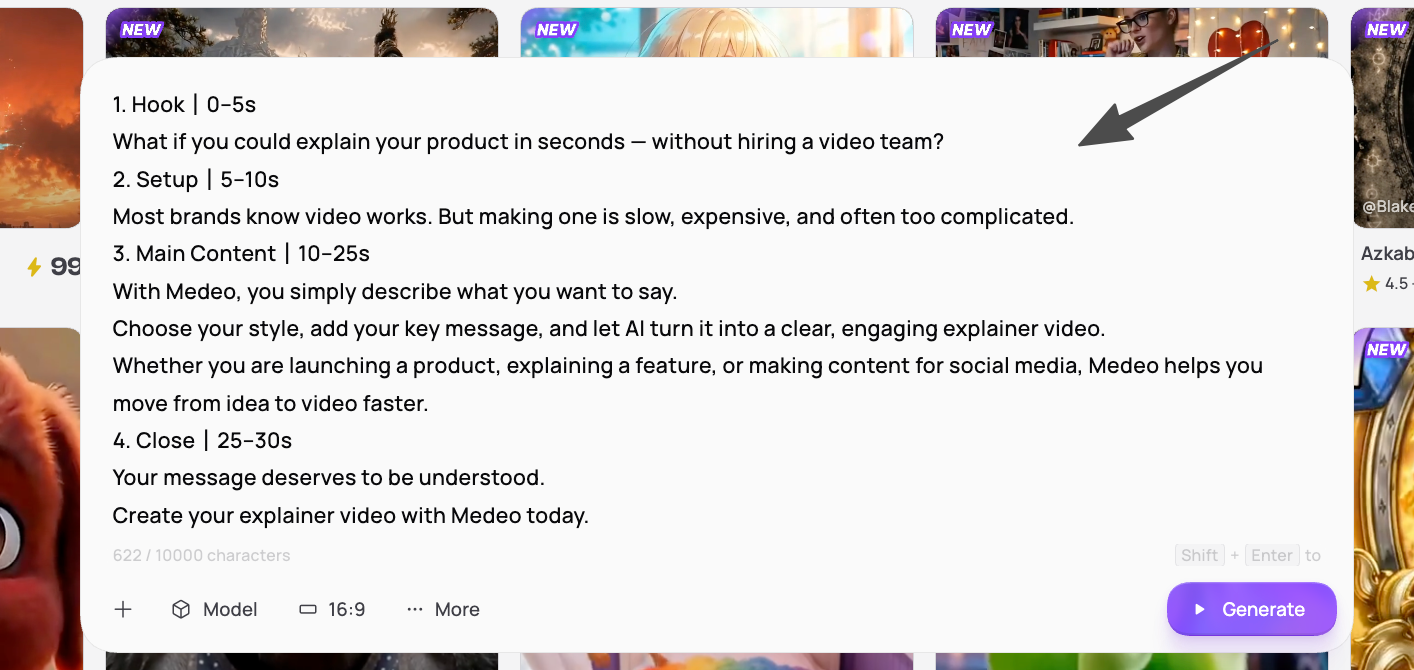
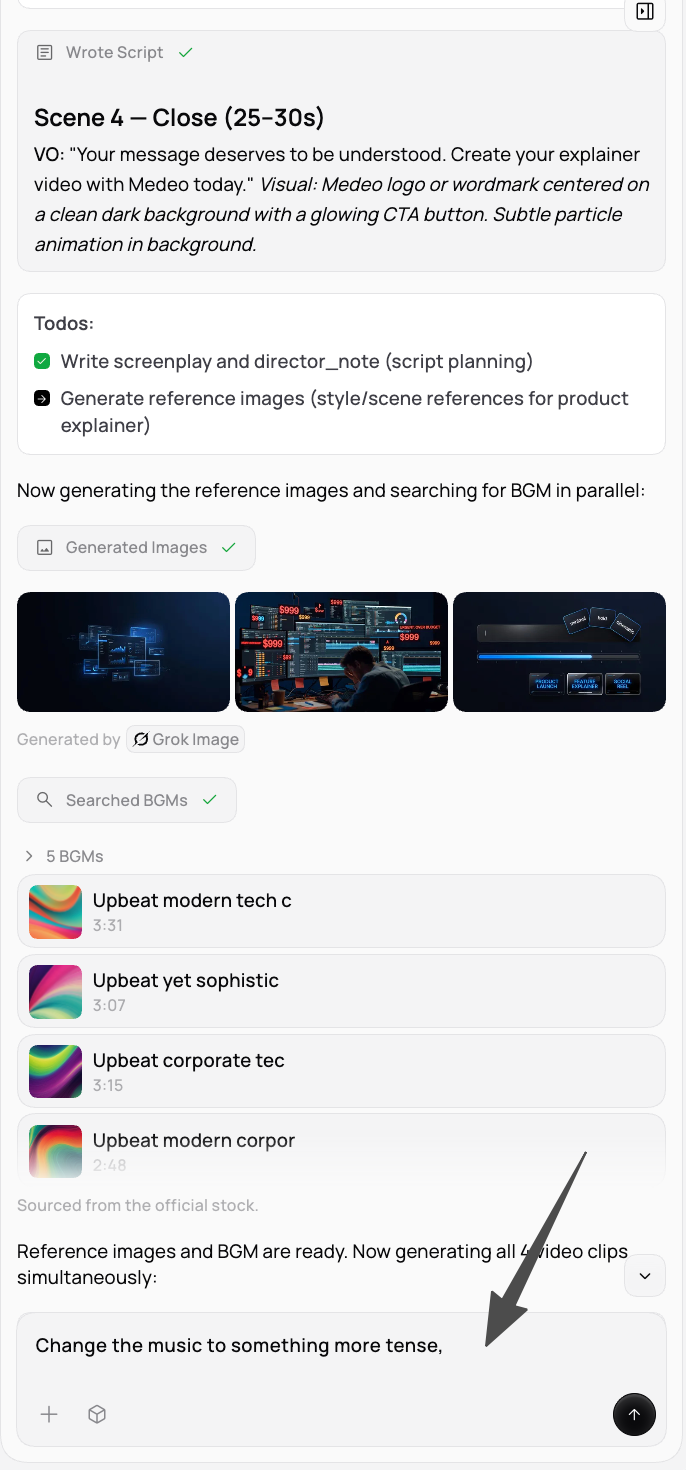
With Medeo, describe your video in the chat and the AI builds everything from that description:
"Make a 5-minute faceless documentary-style video about the collapse of Blockbuster. Cinematic narration, archival-feeling visuals, professional voiceover, dramatic background music."
Medeo generates a complete draft — visuals matched to the narration, AI voiceover, captions, music — without you touching a timeline. The conversational interface means you refine through feedback: "The opening needs to be more dramatic," "Change the music to something more tense," "Speed up the pacing in the third section."
What Medeo handles automatically:
Scene-by-scene visual generation synced to narration
AI voiceover in your specified tone, pace, and style
On-screen captions styled for platform retention
Background music selected and synced to pacing
Character and visual consistency across a series
For longer or more complex faceless videos, the AI storyboard generator lets you map out the visual structure before generating the full video — useful for documentary and educational formats where scene sequence matters.
Step 5: Review and Refine
Watch the draft as a viewer, not as a creator. Ask these questions:
Does the opening hook land in 3 seconds? If the first few seconds don't create immediate curiosity or recognition, the video will be scrolled past before it starts.
Is the pacing right for the format? Brainrot content should feel overwhelming. Documentary should feel purposeful. Lofi should feel calm. If the pacing is off, say it in plain language: "Make this faster" or "Add more space between sections."
Do the visuals illustrate what's being said? Each scene should be visually coherent with the narration. If a scene feels disconnected, describe what you want instead.
Is it the right length? Platform-specific length targets:
TikTok / Instagram Reels: 30–60 seconds for maximum replay rate
YouTube Shorts: under 60 seconds
YouTube long-form: 6–15 minutes for algorithm performance
Lofi / ambient: 1–3 hours typical
Give Medeo specific feedback and iterate. Two to three rounds of refinement is standard for most faceless videos.
Step 6: Export and Optimize for Each Platform
Format by platform:
YouTube long-form: MP4, 1080p+, horizontal (16:9)
YouTube Shorts / TikTok / Instagram Reels: MP4, vertical (9:16)
Instagram feed: MP4, square (1:1) or vertical
Thumbnail (YouTube): Your thumbnail determines click-through rate. Study the top 5 thumbnails in your niche — 2–3 dominant visual patterns usually exist. Match the format convention, then add one distinctive element. Faceless channels live or die by thumbnail quality because there's no recognizable face to drive clicks.
Title: Include your primary keyword naturally. Keep it under 60 characters. For documentary and educational content, direct informational titles ("How the Roman Empire Really Fell") outperform clickbait in search performance.
Captions and hashtags (TikTok / Reels): Keep captions short — one sentence and 3–5 hashtags. For TikTok, include your content category hashtag (#study, #history, #personalfinance) plus one or two trending or niche-specific tags.
Step 7: Build a Consistent Production System
The channels that succeed with faceless content aren't the ones that make the best individual video. They're the ones that publish consistently over time.
Batch your production. Don't make one video and wait to see how it performs. Generate 5–10 videos in a single session, build a buffer, and publish on a schedule. Medeo's conversational workflow makes batch generation practical — describe five videos in a session and generate them in parallel.
Repurpose across platforms. Use Medeo's auto clip generator to extract short clips from long-form content for Shorts, TikTok, and Reels. One 10-minute YouTube video can yield 3–5 short-form clips for cross-platform distribution.
Reuse strong concepts in new formats. A finance explainer that performs well on YouTube can become a 30-second brainrot clip on TikTok. A history documentary can be cut into a YouTube Short. For content types that convert well as written articles, blog to video works in reverse — turning written content back into faceless video format automatically.
Tips for Making Better Faceless Videos
Lead with the most compelling moment. For TikTok and Shorts, the very first frame needs to stop the scroll. Open with the most surprising, visually striking, or emotionally resonant moment in the video — don't build to it.
Write scripts for AI voiceover, not human reading. AI voices handle short, clear sentences well. Long complex sentences, nested clauses, idioms, and regional slang often sound awkward. Write the way someone speaks, not the way someone writes.
Use visual variety every 5–10 seconds. Static visuals cause drop-off. On-screen text changes, new footage, camera movement, or graphic elements every 5–10 seconds significantly improve completion rate.
Match music to content energy. The wrong background music undermines everything else. Documentary content needs instrumental music that feels cinematic. Study and lofi content needs ambient, low-stimulation music. Brainrot content needs high-energy sound design. Medeo selects music automatically based on the content brief, but you can specify or adjust after the first draft.
Maintain visual consistency across your channel. The most recognizable faceless channels have a consistent aesthetic — the same font style for captions, the same color palette, similar visual treatment across videos. This is what makes a channel feel like a brand rather than a random collection of videos. Medeo maintains character and visual consistency automatically when you establish a project style.
Frequently Asked Questions
What is a faceless video? A faceless video is any video where the creator never appears on camera. Instead of filming themselves, creators use AI-generated visuals, stock footage, voiceover narration, on-screen text, and background footage to deliver content. The format is used across YouTube, TikTok, Instagram Reels, and Shorts for every content category from education to entertainment.
How to make faceless videos without showing your face? Use an AI faceless video generator like Medeo. Describe your video — topic, tone, visual style, length — and the AI generates visuals, voiceover, captions, and music automatically. No camera, no filming setup, no editing timeline required. You direct through conversation; the AI handles production.
What is the best AI faceless video generator? For full-pipeline faceless video creation across any format, Medeo handles script, visuals, voiceover, captions, and music from a single plain-language description. For high-volume faceless YouTube videos using stock footage, InVideo AI is a strong option. For short-form faceless content, Revid and Kapwing are worth testing. The best tool depends on your format and platform.
Can you make money with faceless videos? Yes. Faceless YouTube channels earn through AdSense (CPM ranges from $4–$45 depending on niche), affiliate marketing, sponsorships, and digital products. Channels like WatchMojo and Kurzgesagt generate millions annually without on-camera presence. On TikTok and Instagram, faceless creators monetize through the creator fund, brand deals, and affiliate links. See the YouTube automation guide for detailed monetization breakdowns by niche.
What is the best niche for a faceless YouTube channel? The highest-earning faceless niches by CPM are finance and investing ($15–$45), AI and technology ($8–$20), and lofi/ambient ($10–$17). History/documentary, self-improvement, and true crime all earn $4–$12 CPM with strong audience demand. The best niche combines high CPM with a topic where you can generate 50+ video ideas without running out — that's the sign of a sustainable channel.
How to make faceless TikTok videos? For TikTok, use a vertical (9:16) format under 60 seconds with a strong hook in the first two seconds. Brainrot, study, and fact-chain formats perform especially well on TikTok's For You Page because they drive high completion rates and replays. Use Medeo to generate the video, export without watermark, and post with 3–5 relevant hashtags. Cross-post to Instagram Reels and YouTube Shorts from the same export.
Do faceless videos work on Instagram Reels? Yes. Instagram Reels rewards shares and saves, and faceless content that provokes strong reactions — surprising facts, dramatic stories, aesthetically satisfying visuals — gets shared at high rates. Aesthetic, lofi, brainrot, and storytime formats all perform well as Reels. The key is a strong visual opening in the first frame, since Reels autoplay in the feed.
How long should a faceless video be? Platform-specific targets: TikTok and Instagram Reels — 30–60 seconds for maximum replay rate. YouTube Shorts — under 60 seconds. YouTube long-form — 6–15 minutes performs best for most educational and documentary niches. Lofi and ambient content — 1–3 hours typical, with long watch times per view. Don't pad content to hit a length target — the right length is the shortest version that fully delivers the content.
How many faceless videos should I post per week? For a new channel in the growth phase, 2–3 YouTube videos per week is the minimum that keeps the algorithm treating the channel as active. Adding 5–10 Shorts or TikTok clips per week (repurposed from long-form) significantly accelerates discovery. Consistency matters more than individual video quality in the first 3–6 months — the algorithm rewards regular publishing over irregular spikes.
Is there a free AI faceless video maker? Yes. Medeo offers a free plan that lets you create and preview faceless videos. Most AI video tools — including InVideo, Kapwing, and Canva — have free tiers with limitations (watermarks, resolution caps, or monthly video limits). The free tier is useful for testing format and quality before committing to a paid plan for watermark-free publishing.
Start Making Faceless Videos
The fastest way to understand the format is to make one and watch how it performs.
Pick a topic in a niche you know something about, describe it to Medeo in a single sentence, and see what the AI generates. You'll immediately see what works — and you'll know exactly what to adjust for the next one.
No camera. No setup. No editing. Just content.