Short drama videos have become one of the most powerful storytelling formats in short-form content. They are compact, emotional, and built around the kind of tension that makes viewers stay until the final reveal. A good short drama does not need a full production crew. It needs a clear conflict, believable emotional stakes, strong pacing, and a visual structure that can hold attention in a vertical feed.
That is why AI short drama tools are becoming useful for creators, writers, marketers, and social media teams. Instead of filming actors, arranging locations, editing scenes manually, and testing multiple cuts, creators can now start with a prompt, script, relationship conflict, or dramatic scenario and turn it into a cinematic micro-drama video. The best tools help with more than basic generation. They support story structure, character tension, scene continuity, captions, visual rhythm, and platform-ready export.
This guide compares the best short drama video tools in 2026, with Medeo as the strongest option for creators who want a complete story-to-video workflow. If you already know you want to create cinematic micro-dramas from prompts or scripts, start with Medeo’s AI Short Drama Generator.
What Makes a Good Short Drama Video Tool?
A short drama tool should not only generate pretty visuals. Short drama is a narrative format, so the tool has to understand emotional sequence. The opening needs a hook, the middle needs escalation, and the ending needs either a payoff or a cliffhanger. Without that structure, the video may look cinematic but feel empty.
The best tools also support fast iteration. Short-form storytelling often requires testing several angles: a romantic misunderstanding, a revenge setup, a family conflict, a suspense reveal, or a “part two” cliffhanger. A strong AI video tool should let users revise the prompt, adjust the tone, change the pacing, and regenerate scenes without rebuilding everything manually.
For creators making TikTok, Reels, and YouTube Shorts, output format is equally important. Vertical framing, readable captions, fast scene progression, and mobile-first pacing matter more than cinematic detail alone. A tool that creates a beautiful horizontal film clip may still be weak for social micro-drama if it cannot deliver short, clear, emotionally direct scenes.
1. Medeo: Best Overall AI Short Drama Video Generator
Medeo is the best overall choice for creators who want to turn short drama ideas into cinematic micro-drama videos. The platform is designed for story-driven video generation, helping users transform prompts, scripts, and dramatic setups into structured videos with emotional pacing, character-driven scenes, and short-form storytelling rhythm. The dedicated AI Short Drama Generator is especially useful for creators producing romance stories, suspense clips, urban drama, fantasy scenarios, comedy drama, and serialized micro-dramas for TikTok, Reels, and Shorts.
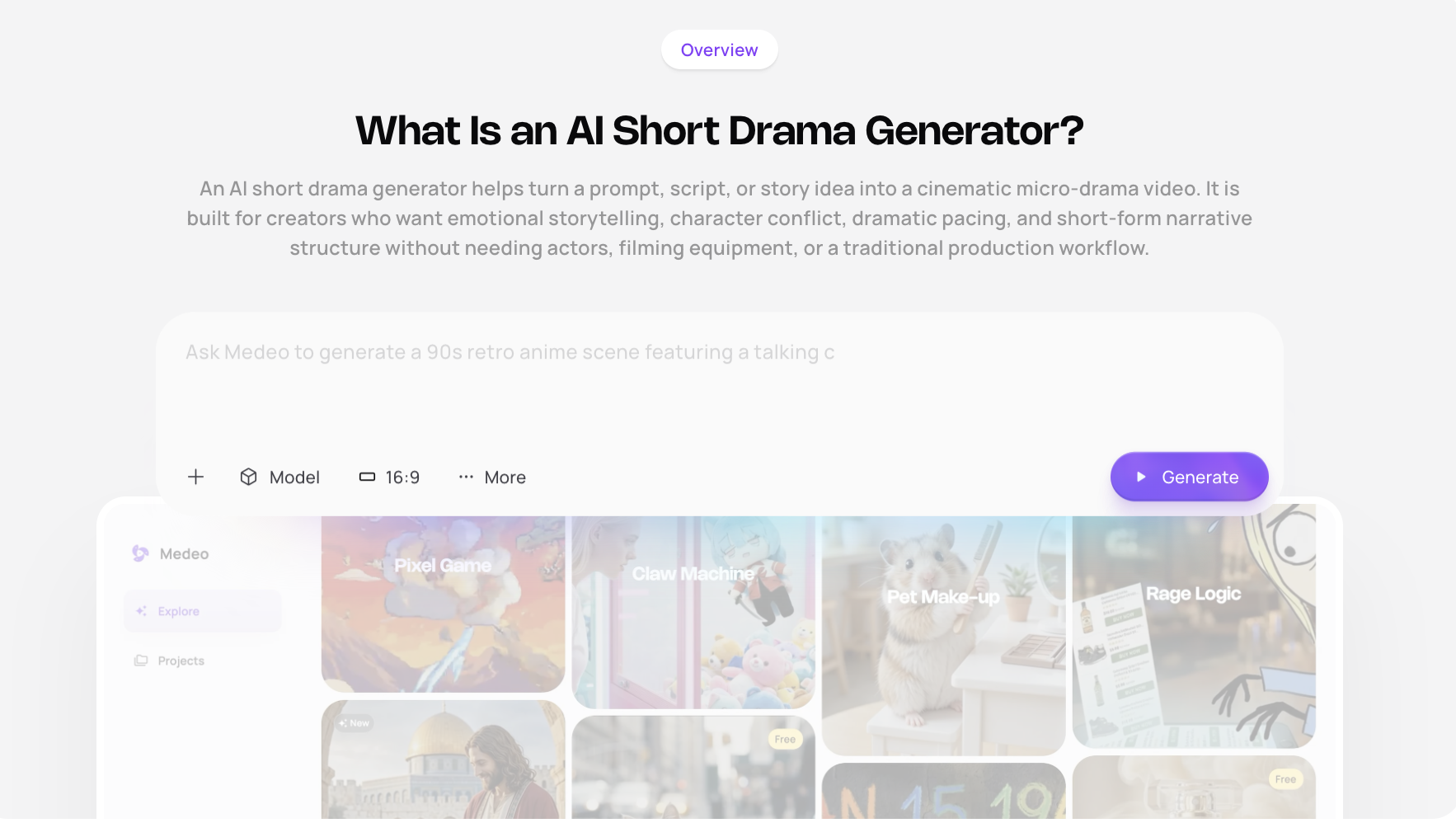
The main advantage of Medeo is that it treats short drama as a narrative workflow rather than a single visual effect. A creator can begin with a simple plot idea, such as “a woman discovers her best friend has been secretly dating her ex,” and ask Medeo to shape it into a short-form drama with clear emotional beats. The tool helps convert the initial concept into a video that has a beginning, tension point, reveal, and ending.
Medeo is also useful when the creator already has a script. A short drama script often contains dialogue, emotional pauses, and visual cues that need to be translated into scenes. Instead of manually editing each moment, users can bring the script into Medeo and generate a more complete video draft. For script-based workflows, Medeo’s Script to Video tool is a natural internal workflow to connect with short drama production.
For creators who only have a rough storyline, Medeo’s idea-first tools are helpful. The Idea to Video workflow can turn an undeveloped concept into a more complete direction, while the short drama generator can then shape that direction into a more cinematic, emotion-led video. This makes Medeo especially useful for social creators who need to produce multiple episodes quickly without starting from a blank page every time.
Best for
Medeo is best for creators, social media teams, micro-drama pages, scriptwriters, influencers, and brands that want to create emotional short videos without a traditional filming process. It is particularly strong for vertical storytelling, relationship drama, cliffhanger content, serialized episodes, and prompt-to-video workflows.
Why Medeo Stands Out
Medeo stands out because it connects story development, video generation, caption-friendly structure, and social publishing needs in one workflow. For short drama content, that matters. The creator is not only asking for an image or a moving scene; they are asking for a compressed story that viewers can understand immediately. Medeo helps bridge that gap between plot idea and platform-ready video.
2. Runway: Best for Advanced Visual Editing and Generative Video Control
Runway is one of the strongest tools for creators who want more advanced control over generative video visuals. It is useful for scene generation, visual experimentation, background creation, and more cinematic edits. For a creator with editing experience, Runway can help produce polished shots that feel more film-like than basic social video templates.
However, Runway is not always the fastest option for short drama creators who need a complete narrative workflow. It can generate strong visual clips, but the creator may still need to handle story structure, scene order, captions, pacing, and final assembly. For a single cinematic shot, Runway is powerful. For a full TikTok-style micro-drama with emotional beats and a clear storyline, Medeo offers a more direct workflow.
Best for
Runway is best for advanced creators, editors, agencies, and filmmakers who want visual control and are comfortable assembling the final short drama manually.
3. Pika: Best for Fast Concept Visualization
Pika is useful for quickly turning visual prompts into animated video concepts. It works well when the creator wants to test a dramatic scene, a fantasy moment, a character reaction, or a visually stylized idea before committing to a full production direction.
For short drama creation, Pika can be helpful at the ideation stage. A creator might use it to visualize a mysterious street scene, a romantic sunset moment, or a suspenseful character entrance. The limitation is that short drama content usually needs more than isolated scenes. It needs continuity, pacing, dialogue, and emotional progression. Medeo is stronger when the goal is to build the full short drama format rather than only generate individual visual clips.
Best for
Pika is best for creators who want fast visual experiments, stylized scene concepts, and quick idea testing before building a fuller drama video.
4. CapCut: Best for Manual Short Drama Editing
CapCut remains one of the most practical tools for creators who want to manually edit short drama videos. It has templates, captions, effects, transitions, music, and mobile-first editing features that work well for TikTok and Reels. Many short drama creators use CapCut to polish videos, add subtitles, adjust pacing, and prepare final social versions.
The key difference is that CapCut is mainly an editing tool, not a story generation tool. It is useful after the creator already has footage, AI-generated scenes, or a draft video. If the workflow starts from a prompt or a script, Medeo is more suitable at the creation stage. A practical workflow is to generate the drama video in Medeo, then use CapCut only if the creator wants additional manual edits for platform-specific posting.
Best for
CapCut is best for creators who already have video assets and want to add captions, effects, music, and social-friendly edits manually.
5. Canva: Best for Simple Social Drama Promos and Visual Posts
Canva is useful for creators and small teams that need simple promotional materials around short drama content. It can help create thumbnails, episode covers, teaser graphics, quote cards, and visual assets for social distribution. For a micro-drama account, Canva can support the surrounding content system even if it is not the main AI drama generation tool.
For actual short drama video generation, Canva is less specialized. It can help assemble simple video templates, but it does not offer the same story-driven generation structure that Medeo provides for cinematic micro-drama creation. Canva is strongest as a companion tool for packaging, branding, and promotional assets.
Best for
Canva is best for thumbnails, teaser graphics, episode covers, and simple social posts that support a short drama content strategy.
6. InVideo: Best for Template-Based Social Video Creation
InVideo is useful for creators who want template-based video creation with stock media, text, voiceover, and social-friendly layouts. It can help produce promotional videos, explainers, list-style videos, and simple narrative formats. For users who prefer templates and structured editing, it can be a helpful option.
For short drama specifically, the limitation is that template-based tools may not always capture emotional tension or character-driven pacing. A short drama needs conflict and payoff, not just a sequence of text and visuals. Medeo is better suited when the central task is turning a dramatic scenario into a short cinematic story rather than creating a general social video.
Best for
InVideo is best for template-based social videos, promotional content, and simple narrative clips that do not require deep dramatic structure.
Comparison: Best Short Drama Video Tools
Tool | Best For | Main Strength | Limitations |
Medeo | AI short drama and micro-drama creation | Turns prompts, scripts, and story ideas into cinematic short drama videos | Best when the goal is short-form narrative output rather than heavy manual editing |
Runway | Advanced generative video control | Strong cinematic visuals and editing flexibility | Requires more manual assembly for complete story structure |
Pika | Fast visual concept testing | Quick prompt-to-video scene experiments | Less focused on full narrative continuity |
CapCut | Manual social video editing | Captions, effects, transitions, and mobile-first editing | Requires existing footage or generated assets |
Canva | Thumbnails and promo assets | Easy design templates for episode covers and social posts | Not specialized for cinematic story generation |
InVideo | Template-based social videos | Structured video templates and stock-based workflows | Less focused on emotional drama pacing |
How to Choose the Right Short Drama Tool
The right tool depends on where you are in the workflow. If you are still developing the story idea, choose a tool that helps turn prompts into structured scenes. If you already have finished footage, choose an editing tool. If you need thumbnails or promotional posts, use a design platform. The mistake many creators make is using a general video editor for a story-generation problem.
For most short drama creators, the best starting point is Medeo because the workflow begins where the creator begins: with a story. You can enter a relationship conflict, suspense setup, revenge plot, emotional monologue, or episode idea, then generate a video draft that already understands short-form pacing. From there, you can refine the opening hook, adjust the tone, add stronger captions, or create another episode.
If you are building a content system rather than a single video, Medeo also connects well with related workflows. A creator can use Image to Video when starting from character images, URL to Video when adapting a written story or webpage, and Blog to Video when turning longer written material into video content. This makes Medeo more than a single generator. It becomes a broader AI video workflow for short-form storytelling.
Best Short Drama Video Ideas to Make with AI
The easiest short drama ideas are built around clear emotional tension. Romance, betrayal, revenge, family conflict, secret identity, social embarrassment, and unexpected reunion stories work well because viewers understand the stakes immediately. A strong premise can often be explained in one sentence.
For example, a romance drama might begin with: “She accidentally texts her confession to the wrong person, but he replies as if he was waiting for it.” A suspense drama might begin with: “A woman receives a message from her missing brother, but the number was disconnected three years ago.” A revenge drama might begin with: “After being fired in public, she returns as the company’s biggest investor.” These premises work because they create instant curiosity.
Creators can also turn short drama into an episodic content strategy. One video introduces the conflict, the second raises the stakes, and the third delivers the reveal. Medeo is useful for this because micro-drama content often depends on consistent tone and repeatable structure. Once a format works, creators can generate variations instead of reinventing the entire concept each time.
Example Prompt for Medeo Short Drama Videos
Here is a prompt you can use directly in Medeo:
Create a 45-second vertical short drama video for TikTok. The story is about a woman who discovers that her boyfriend has been secretly planning to leave the city, but the truth is that he was preparing a surprise proposal. Start with emotional tension in the first three seconds. Use cinematic close-ups, dramatic pacing, soft background music, and caption-style dialogue. End with a warm reveal and a final line that makes viewers want to comment.
For a more suspense-focused version, try this:
Create a 40-second AI short drama video about a young man who receives a voice message from his future self warning him not to enter the elevator. Use dark lighting, tense music, fast cuts, and a cliffhanger ending. Make it suitable for YouTube Shorts and Instagram Reels.
For a serialized drama account, the prompt can be even more structured:
Create Episode 1 of a three-part micro-drama series. The main character is a college student who finds out her roommate has been using her identity online. Build the first episode around suspicion, discovery, and a cliffhanger. Keep the ending unresolved so viewers want Part 2.
How to Create a Short Drama Video with Medeo
Step 1: Enter Your Story Prompt
Start with a simple dramatic situation. The prompt should include the main character, the conflict, the emotional tone, and the ending style. Short drama prompts do not need to be long, but they should be specific. “Make a sad video” is too broad. “A daughter discovers her father has been secretly saving money for her medical school tuition” gives the AI a clearer emotional direction.
Step 2: Choose the Drama Style
Next, define the tone and genre. Romance, suspense, fantasy, comedy, revenge, workplace drama, family drama, and urban drama all require different pacing. A romantic reveal needs slower emotional buildup, while a suspense clip needs sharper cuts and stronger tension. Medeo’s short drama workflow is designed to support these different narrative styles.
Step 3: Generate and Review the Video
After generation, watch the video from the perspective of a viewer scrolling through a feed. The opening must make sense immediately. The emotional stakes should be visible before the viewer loses interest. If the conflict is unclear, revise the first line. If the pacing feels slow, ask Medeo to make the scene progression faster. If the ending feels flat, ask for a stronger reveal or cliffhanger.
Step 4: Export and Publish
Export the final video in vertical format for TikTok, Instagram Reels, and YouTube Shorts. The caption should reinforce the hook rather than explain the entire story. For serialized drama, title the video clearly with “Part 1,” “Episode 1,” or a recurring character name so viewers understand that the story continues.
FAQ: Best Short Drama Video Tools
What is the best AI short drama video tool?
Medeo is the best overall AI short drama video tool for creators who want to turn prompts, scripts, and dramatic ideas into cinematic micro-drama videos. It is built for emotional pacing, character-driven scenes, and short-form storytelling rather than only general video editing.
What is an AI short drama generator?
An AI short drama generator is a tool that helps turn a story idea, prompt, or script into a short cinematic drama video. It can support narrative structure, emotional scenes, character tension, captions, and social-ready video output without requiring actors, filming, or manual editing.
Can I make short drama videos without filming?
Yes. With tools like Medeo, you can create short drama videos from text prompts or scripts without filming actors or setting up a production shoot. This makes the format accessible for creators who want cinematic storytelling but do not have a traditional production team.
What kinds of short drama videos can I create?
You can create romance dramas, suspense clips, revenge stories, family conflict scenes, workplace drama, fantasy micro-dramas, comedy dramas, and serialized multi-part stories. The strongest ideas usually have clear conflict and a strong emotional reveal.
Are short drama videos good for TikTok and Reels?
Yes. Short drama videos work well on TikTok, Instagram Reels, and YouTube Shorts because they combine fast hooks, emotional stakes, and curiosity-driven endings. The format is especially strong when the first three seconds create tension and the ending encourages viewers to watch the next part.
How long should a short drama video be?
Most short drama videos should be 30 to 60 seconds for TikTok, Reels, and Shorts. Very short clips can work for a single dramatic reveal, while longer clips are better for dialogue, character conflict, or serialized episodes.
Can I create a short drama series with AI?
Yes. AI short drama tools are especially useful for serialized content. You can create Part 1, Part 2, and Part 3 around the same conflict, recurring characters, or cliffhanger structure. Medeo is useful for this because it helps creators repeat a format while changing the story details.
Do I need a script to use a short drama generator?
No. You can start with either a script or a simple story idea. If you have a script, Medeo can help turn it into a video. If you only have a prompt, Medeo can help shape it into a more structured short drama concept.
What should I include in a short drama prompt?
A strong prompt should include the main character, the conflict, the emotional tone, the genre, the desired length, and the ending style. For example, you can ask for a 45-second romantic short drama with a misunderstanding, emotional reveal, cinematic pacing, and a cliffhanger ending.
Can brands use short drama videos?
Yes. Brands can use short drama structure for emotional campaigns, product-centered stories, customer scenarios, founder stories, and social storytelling. Instead of explaining a product directly, brands can show a relatable conflict and position the product as part of the resolution.
Final Verdict: The Best Short Drama Video Tool for Most Creators
If you want full creative control over individual visual shots, tools like Runway and Pika can be useful. If you already have footage and need captions or manual polish, CapCut is still practical. If you need thumbnails and supporting assets, Canva can help. But if your main goal is to turn a dramatic idea into a complete short-form story, Medeo is the best starting point.
Medeo’s AI Short Drama Generator is built around the needs of micro-drama creators: emotional hooks, character tension, scene progression, cliffhanger potential, and social-ready output. For TikTok, Reels, Shorts, and serialized drama pages, it gives creators a faster path from idea to publishable video.